The Acropolis Reimagined
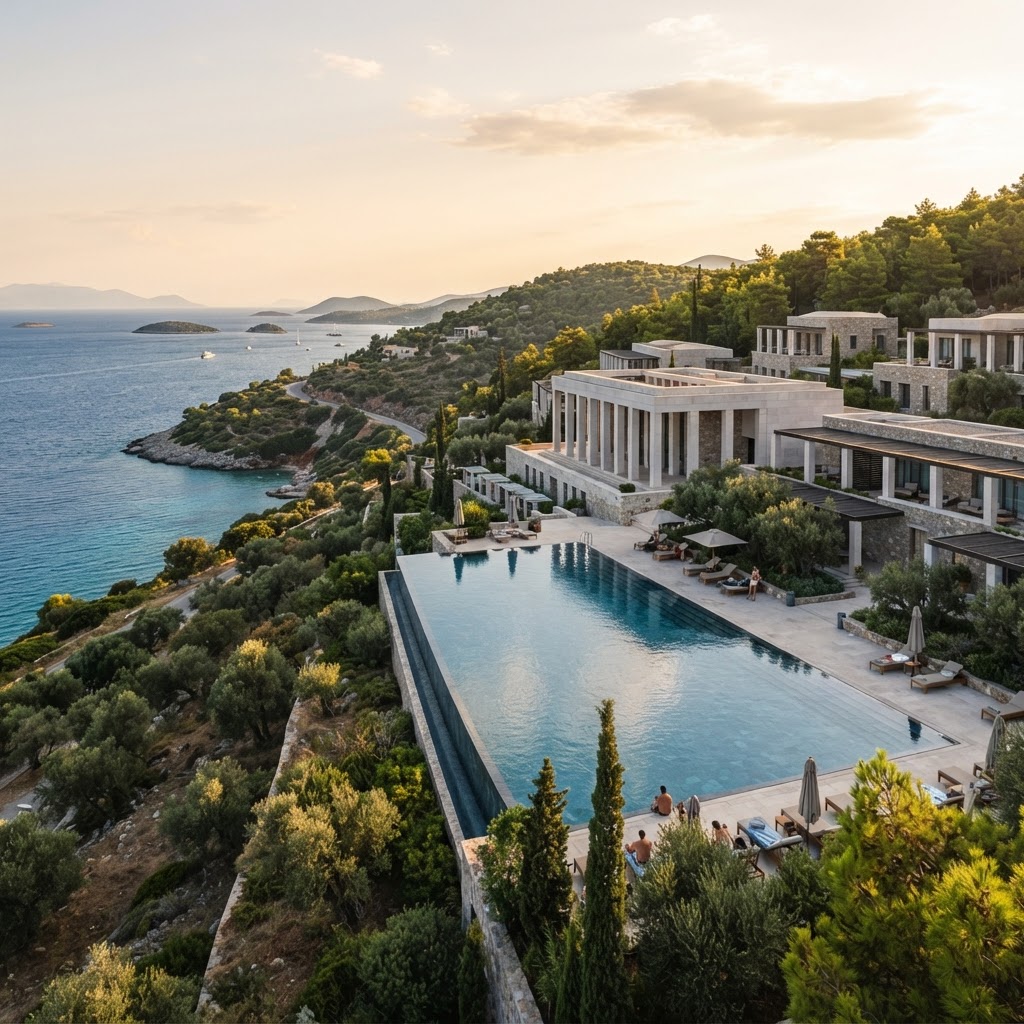
Arriving at Amanzoe, you climb a winding road through olive groves and pine forest, and then the road opens onto a plateau — and there it is. A colonnaded structure of pale stone, framed by cypress trees, rising from the hilltop like a temple. The resemblance to the Acropolis is not accidental. Amanzoe — the name combines 'Aman' (peace) with 'zoe' (life in Greek) — was conceived by its architect, Edward Tuttle, as a modern interpretation of the ancient Greek sanctuary: a place of columns, terraces, and views, set on a high point above the sea, where the mind can find stillness.
The comparison is not grandiose. It is earned. Amanzoe sits on a hilltop near Porto Heli, on the east coast of the Peloponnese — the peninsula that was the heartland of ancient Greek civilisation, home to Mycenae, Epidaurus, Olympia, and some of the most important ruins in the Western world. From the resort's terraces, you can see olive groves stretching to the horizon, the Aegean Sea glittering below, and, on a clear day, the islands of Spetses and Hydra floating in the distance. It is a view that has not changed in two and a half thousand years, and Amanzoe was designed to frame it, not to compete with it.
For Aman — the brand that pioneered quiet, architectural luxury — Amanzoe was a homecoming. The Peloponnese is the birthplace of the values that define Aman: harmony with the landscape, respect for history, and the conviction that the greatest luxury is space, silence, and beauty. Amanzoe is the Aman philosophy expressed in Greek, and it is one of the finest hotels in Europe.
The Architecture: A Temple for the Living
Edward Tuttle, who also designed Amanpuri in Phuket, was the natural choice for Amanzoe. His work is defined by a respect for local architectural traditions, reinterpreted with a modernist's eye for proportion and light. At Amanzoe, he took the vocabulary of ancient Greek architecture — the column, the terrace, the courtyard, the threshold — and stripped it to its essence.
The result is a building that feels less like a hotel and more like a sanctuary. The main structure is a long, low pavilion of pale limestone and white marble, with a colonnade of slender pillars that casts shifting patterns of light and shadow across the terraces. The interiors are deliberately spare: limestone floors, white walls, oak furniture, and almost nothing else. The aesthetic is not minimalism for its own sake — it is restraint in the service of the view, which is the true masterpiece here.
The scale is grand but the feeling is intimate. The hotel has only 38 pavilions and villas, spread across a large hillside site, so that guests rarely see or hear each other. The public spaces — the restaurant, the bar, the pool, the spa — are positioned along a central axis that runs from the entrance to the edge of the cliff, so that every step you take through the hotel reveals a new perspective on the view. It is architectural choreography, and it is masterfully done.
The Pavilions: Space, Light, and a Private Pool
Every guest at Amanzoe stays in a pavilion or villa with a private pool. There are no standard rooms, no shared spaces, no compromises. This is the Aman way, and at Amanzoe it reaches its fullest expression.
The Pavilions
The 32 pavilions are the entry-level accommodation, but 'entry-level' at Aman is a category that most hotels would call their top suite. Each pavilion is a standalone structure — a cube of pale stone and glass, set on the hillside among olive trees, with a bedroom, a bathroom, a living area, and a private terrace with a swimming pool.
The pools are the centrepiece. The Deluxe Pavilions come with 12-metre pools positioned so that the water appears to spill over the edge into the olive groves below. The effect, particularly at sunset, is extraordinary: you are floating in a pool of turquoise water, surrounded by the silver-green of olive trees, with the Aegean stretching to the horizon. It is one of the great hotel pool views in the world.
The interiors are classic Aman: limestone floors, white walls, a bed dressed in white linen, a writing desk, and a bathroom with a deep soaking tub positioned to look out over the view. The furniture is custom-designed — oak, leather, linen — and the lighting is soft and indirect. The technology (climate control, sound system, lighting) is present but invisible. The effect is of a space that has been designed not to impress you but to calm you.
The Beach Pavilions
For those who prefer to wake to the sound of waves rather than the silence of the hilltop, the Beach Pavilions are positioned directly on the beach, a short drive (or funicular ride) from the main resort. These are smaller than the hilltop pavilions but have direct access to the sand and the sea. The pools are smaller, but you step off your terrace onto the beach — and for many guests, that trade is worth it.
The Villas
The villas are the ultimate Amanzoe address. Surrounded by olive groves with panoramic views of the Aegean, each villa has multiple bedrooms, a large private pool, a full kitchen, and a dedicated staff. The Villa 1 is the flagship — a compound with a 25-metre pool, an outdoor dining pavilion, a private spa room, and interiors that read like a private home rather than a hotel room. These are the villas that attract the sort of guests whose names you would recognise — and the sort of discretion that ensures you never will.
The Beach Club: The Aegean's Shore
Amanzoe's Beach Club sits at the foot of the hill, accessible by a short drive or the resort's funicular. It is a different world from the hilltop — not a temple but a pavilion, open to the sea, with sun loungers, a restaurant, and a bar set on a stone terrace above a private pebble beach.
The water here is among the clearest on the Peloponnesian coast — a turquoise so vivid it seems lit from below. The beach is small and exclusive, reserved for hotel guests. Sun loungers are spaced generously. The staff bring cold towels, fruit, and water without being asked. The standard of service is what you would expect from Aman — anticipatory without being intrusive.
For those who prefer a pool to the sea, the Beach Club also has a large infinity pool overlooking the water, with sun loungers and a bar. It is the more social of Amanzoe's two pool areas — the hilltop pool is for contemplation, the beach club pool is for afternoon conviviality.
Water Sports and Boating
The Beach Club offers water sports — sailing, paddleboarding, water skiing, and snorkelling. The resort has its own boat, available for private charter, and the skipper can take guests along the coast to hidden coves and beaches, or across to the island of Spetses for lunch and a swim. A day on the water, with a picnic prepared by the hotel, is one of the great Amanzoe experiences.
Dining: Greek, Mediterranean, and Japanese
Amanzoe has three restaurants, each with a distinct personality, and the standard across all three is exceptionally high. The cuisine spans Greek, Mediterranean, and Japanese — a range that reflects both the resort's location and the Aman brand's global sophistication.
The Restaurant
The main restaurant — simply called The Restaurant — is the heart of Amanzoe's dining scene. Set in the main pavilion, with a terrace overlooking the pool and the sea, it serves Greek and Mediterranean cuisine with an emphasis on local produce. The menu changes seasonally, but the philosophy is constant: the best ingredients of the Peloponnese — olive oil, vegetables, herbs, fish, lamb — treated with respect and presented with simplicity.
The fish is the star. Caught that morning by local fishermen, it is grilled or baked with olive oil, lemon, and sea salt — the Greek way — and the quality of the ingredient speaks for itself. The lamb, from the mountains of the Peloponnese, is slow-roasted with herbs from the resort's garden. The vegetables — tomatoes, aubergines, courgettes, peppers — are grown locally and taste of the sun that ripened them.
Nama
Nama is Aman's Japanese restaurant, and it is one of the surprises of Amanzoe. Set by the pool, with a terrace overlooking the sea, Nama serves Japanese cuisine — sushi, sashimi, and izakaya-style small plates — that would hold its own in any major city. The fish is flown in, but the vegetables and herbs are local, creating a menu that is Japanese in technique and Greek in spirit. The sushi bar is a particular draw — sitting at the bar, watching the chef work, eating omakase as the sun sets over the Aegean, is one of the most memorable dining experiences at the resort.
The Beach Club Restaurant
The Beach Club restaurant is the most casual of the three, serving light meals, salads, grilled fish, and cocktails throughout the day. It is the perfect spot for a long lunch after a morning in the sea — barefoot, shaded by olive trees, with the water lapping at the terrace below.
The Bar
The Bar is the social hub of the resort in the evening — a sleek, low-lit space with a terrace that offers the best sunset view on the property. The cocktails are excellent — the mixologists use local herbs and fruits, and the wine list is deep in Greek producers. The Assyrtiko from Santorini is the house white, and it is the perfect accompaniment to an Amanzoe sunset.
Nura and Akari
In addition to the three main restaurants, Amanzoe has introduced Nura and Akari — two dining concepts that extend the resort's culinary offering. Nura focuses on Mediterranean cuisine with a contemporary approach, while Akari brings a more intimate, omakase-style experience. Both are available to hotel guests and represent the resort's commitment to culinary excellence.
The Aman Spa: A Sanctuary of Stone and Light
The Aman Spa at Amanzoe is one of the largest and most comprehensive in the Aman collection — a 2,500-square-metre complex set on the hillside below the main pavilion. The design is raw and natural: limestone walls, oak floors, water features, and natural light that filters through floor-to-ceiling windows. The scent of lavender — grown in the resort's garden — permeates the space.
The spa has an indoor pool, a thermal suite (sauna, steam room, cold plunge), a fully equipped gym, and ten treatment rooms, including two couples' suites with private terraces and soaking tubs. The treatments use all-natural products — Greek olive oil, honey, herbs, and sea salt — combined with techniques drawn from Aman's global wellness expertise.
The Signature Treatments
The signature treatment is the Amanzoe Ritual — a two-hour journey that begins with a body scrub using olive oil and sea salt, moves through a massage with warm volcanic stones, and finishes with a facial using Greek honey and lavender. It is the kind of treatment that leaves you in a state of calm so profound that the drive back to your pavilion feels like a meditation.
The Mobility & Recovery Retreat by Novak Djokovic
Amanzoe has partnered with Novak Djokovic — Aman's Global Wellness Ambassador — to create a Mobility & Recovery Programme that is unique to the resort. The programme, rooted in longevity and holistic wellbeing, combines advanced recovery techniques (cryotherapy, compression therapy, infrared sauna) with movement sessions, nutrition, and mindfulness. It is the kind of programme that would not be out of place at a professional sports clinic — and it is available to hotel guests as a multi-day retreat.
The Wellness Programmes
In addition to the Djokovic programme, the spa offers multi-day wellness programmes for detox, stress management, sleep, and fitness. These programmes combine daily treatments, nutritional consultations, fitness sessions, and wellness cuisine, and are personalised to each guest. The programmes can be tailored from three days to two weeks, and the results — particularly for the sleep and stress management programmes — are genuinely transformative.
The Peloponnese: The Heart of Ancient Greece
The Peloponnese is not an island — it is a peninsula, connected to the mainland by the Corinth Canal, and it is the heartland of ancient Greek civilisation. It is home to some of the most important archaeological sites in the world, and Amanzoe is perfectly positioned to explore them.
Epidaurus — a 45-minute drive from the resort — is one of the best-preserved ancient theatres in Greece. Built in the 4th century BC, it seats 14,000 people and has acoustics so perfect that a whisper on stage can be heard in the back row. In summer, the theatre hosts performances of ancient Greek drama, and watching a play in the same theatre where audiences sat 2,400 years ago is one of the great cultural experiences in Europe.
Mycenae — the kingdom of Agamemnon, and the centre of the Mycenaean civilisation — is an hour's drive. The Lion Gate, the Treasury of Atreus, and the palace ruins are among the most evocative archaeological sites in Greece. And the ancient site of Olympia — the birthplace of the Olympic Games — is a three-hour drive but absolutely worth the journey.
Porto Heli and Spetses
The resort is near Porto Heli — a cosmopolitan harbour town that is the Hamptons of Greece, where Athenian families have summered for generations. The harbour is full of sailing yachts, the restaurants are excellent, and the atmosphere is wealthy, relaxed, and distinctly Greek.
A short boat ride across the bay is Spetses — a car-free island of neoclassical mansions, pine forests, and pebble coves. It is one of the most charming islands in the Saronic Gulf, and a day trip to Spetses — arriving by boat, renting a bicycle, eating lunch at a waterfront taverna, swimming in a quiet cove — is one of the great simple pleasures of a stay at Amanzoe.
Hydra
Also accessible by boat is Hydra — the artists' island, where Leonard Cohen lived in the 1960s, and where cars and motorbikes are still banned. The harbour town is a preserved 19th-century masterpiece of stone mansions and narrow lanes, and the island has a bohemian atmosphere that is unique in the Aegean. A day trip to Hydra from Amanzoe — by boat, with lunch arranged by the hotel — is a journey to another era.
Art and Culture at Amanzoe
Amanzoe is not just a hotel — it is a cultural destination. The resort hosts regular exhibitions and events that engage with Greek art and culture, and the 2026 season features 'Life Cycles' — an exhibition in collaboration with Zoumboulakis Galleries, running from May 22 to October 31, offering a multi-generational dialogue between leading Greek female artists. The exhibition is displayed throughout the resort's public spaces, integrating art into the Amanzoe experience in the way that only Aman can.
The resort also hosts cultural events — musical performances, talks, and private dinners in archaeological settings — that connect guests with the history and culture of the Peloponnese. These are not standard hotel activities; they are curated experiences designed for guests who want to engage with the place, not just consume it.
Getting There
Amanzoe is a 2.5-hour drive from Athens International Airport, or a 25-minute helicopter ride. The resort can arrange both transfers, and the helicopter transfer — flying over the Corinth Canal and the Saronic Gulf, arriving at the resort's private helipad — is the recommended option for those who can afford it. The aerial view of the Peloponnese — olive groves, ancient ruins, and the blue Aegean — is the perfect introduction to the resort.
The resort is also a 3-hour drive from Kalamata International Airport, which serves direct flights from several European cities in summer.
Who Will Love Amanzoe
Amanzoe is for travellers who want Greece without the crowds. The Peloponnese is not Santorini or Mykonos — there are no cruise ships, no selfie queues, no packed beaches. It is the Greece of olive groves and ancient theatres, of fishing villages and pine forests, of a civilisation that began here three thousand years ago and left its mark on every hillside and every shore.
It is for those who appreciate architecture as much as scenery — the colonnades, the proportions, the way the light moves through the spaces. It is for couples seeking a sanctuary so quiet and so beautiful that the world feels very far away. It is for families who want to introduce their children to the roots of Western civilisation — in a setting that is itself a modern classic. And it is for anyone who has ever stayed at an Aman and thought: this is how luxury should feel. Amanzoe is Aman at its best — and Aman at its best is the best there is.