The View That Defined a Destination
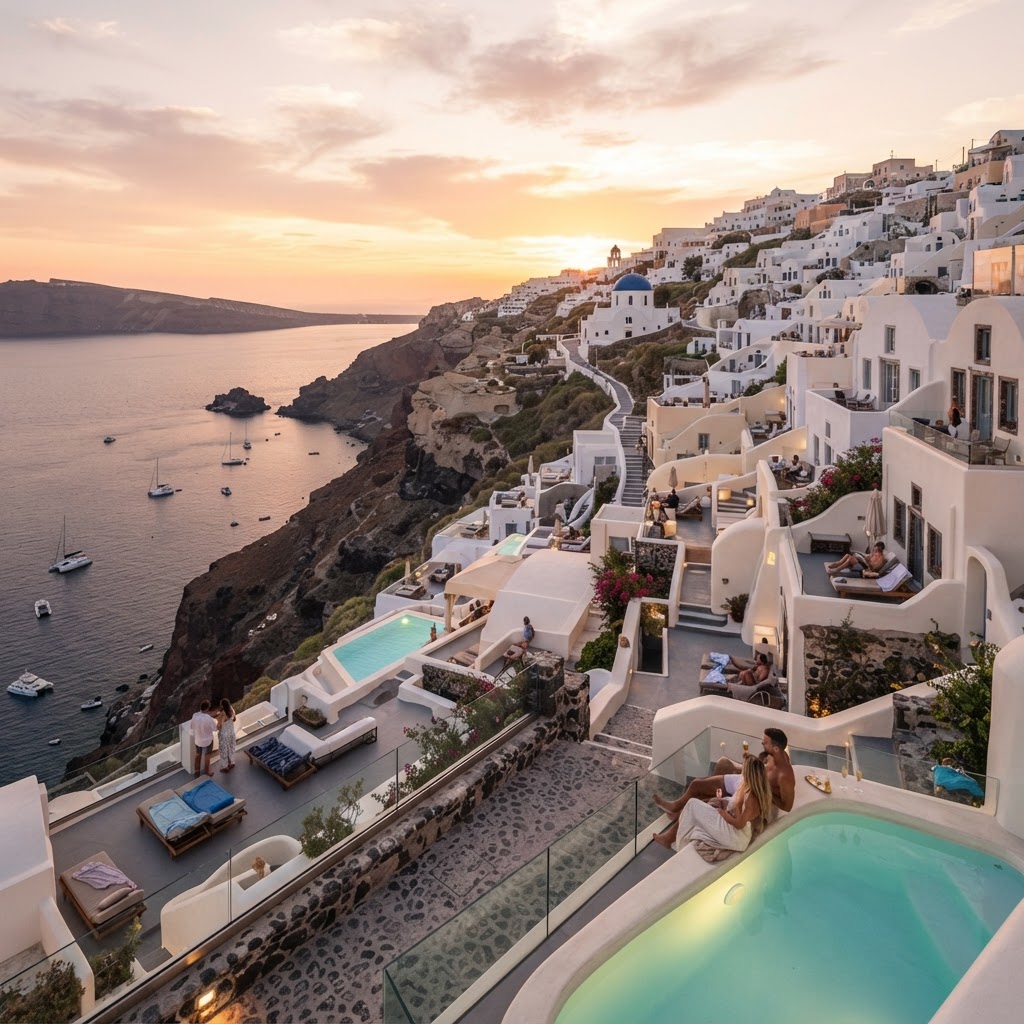
If you have seen a photograph of Santorini, there is a good chance it was taken from Katikies. The hotel's whitewashed terraces, blue-domed church next door, and infinity pools perched on the cliff above the caldera have become the visual shorthand for the island — reproduced on travel guides, Instagram feeds, and screensavers around the world. It is, quite possibly, the most photographed hotel in Greece.
And yet, arriving at Katikies for the first time, the photographs do not prepare you. The caldera is vast — a 300-metre drop from the cliff to the sea, a sweep of volcanic rock that curves around a bay so large it was once a volcano before it erupted and collapsed into the sea 3,600 years ago. Standing on the hotel's terrace, looking out over this impossible landscape, you understand why people cross the world to come here. And you understand why Katikies — which was one of the first luxury hotels on the caldera, and which set the template that every subsequent hotel has followed — still sets the standard.
Katikies is not a large hotel. It has 35 rooms and suites, carved into the cliff and cascading down the rock face in the traditional Santorinian style — white cube houses, linked by narrow stone paths and steps, with terraces and pools at every level. It is a hotel that is scaled to the landscape, not imposed upon it, and the architecture is pure Cycladic vernacular: whitewashed walls, curved lines, arched openings, and a colour palette of white, blue, and the volcanic grey of the cliff.
The Rooms: Carved From the Volcano
The accommodation at Katikies is divided into rooms, suites, and villas, and all share the defining feature of Santorinian architecture: the cave room. Carved into the volcanic rock of the cliff, these rooms are naturally cool in summer and warm in winter, and the thick stone walls create a silence that is almost geological — a deep, ancient quiet that makes the rest of the world feel very far away.
The interiors are whitewashed and spare: white walls, white floors, white linens, and then — the view. Every room at Katikies faces the caldera, and the windows and doors are positioned so that the view is not a backdrop but the room's defining feature. The light in Santorini is extraordinary — clear, intense, and shifting throughout the day — and the rooms are designed to receive it, with arched openings that frame the sea and the sky like paintings.
The Suites
The suites escalate in size and in the size of their terraces. The Junior Suites have a bedroom and a small sitting area, with a caldera-view terrace. The Superior Suites add a separate living area and a larger terrace. The Caldera Suites — the category that most guests aspire to — have private plunge pools on the terrace, positioned so that the pool appears to merge with the caldera below. Floating in a plunge pool, 300 metres above the sea, watching the sun set over the volcano, is the quintessential Santorini experience — and Katikies does it better than anyone.
The Katikies Villa
The Katikies Villa is the hotel's signature: a two-bedroom villa with a private infinity pool, a heated Jacuzzi, a dining area, and a terrace so perfectly positioned that it feels like the prow of a ship suspended above the caldera. The villa has a private entrance and a dedicated butler, and it is the address for those who want the Katikies experience in complete privacy — the sort of guests who arrive by helicopter and leave by yacht.
The Pools: Suspended Above the Sea
Katikies has multiple pools, set at different levels on the cliff, and each is designed to create the illusion that the water flows over the edge and into the caldera below. It is the most effective infinity pool design in Santorini — and Santorini has the most effective infinity pool designs in the world.
The main pool — a long, narrow rectangle set on the highest terrace — is the social heart of the hotel, with sun loungers, a pool bar, and the best caldera view in the property. The lower pools are smaller and more private, positioned on terraces that serve specific suite categories. And the plunge pools in the suites are the most intimate — just you, the water, and the volcano.
Dining: The Caldera as a Dining Room
Katikies has two restaurants and a wine bar, and all three are positioned to make the caldera the dining room. It is, frankly, an unfair advantage — the view is so spectacular that the food could be mediocre and the restaurants would still be memorable — but the food is not mediocre. It is excellent.
The Pool Restaurant
The Pool Restaurant, set on the terrace beside the main pool, serves breakfast and lunch. Breakfast at Katikies is a ritual: Greek yogurt with honey and walnuts, fresh breads, local cheeses, fruit, and eggs any style, served on the terrace as the caldera fills with morning light. Lunch is Mediterranean — salads, grilled fish, pasta — designed for long, lazy afternoons by the pool.
Mikado
Mikado is the hotel's fine dining restaurant, perched on the highest terrace with the most dramatic caldera view. The cuisine is Mediterranean with Japanese influences — a combination that sounds odd and tastes inspired. The sushi and sashimi are excellent, the Mediterranean dishes are accomplished, and the tasting menu — available on request — is a multi-course journey that combines the best of both traditions. The setting, at sunset, is one of the most romantic dining experiences in the Mediterranean.
The Wine Bar
Santorini is one of the great wine islands of the Mediterranean, and Katikies' wine bar — set in a cave carved into the cliff — is the hotel's most atmospheric space. The volcanic soil of Santorini produces wines of extraordinary minerality and acidity — particularly the Assyrtiko grape, which has become one of the most celebrated white wines in the world. The wine bar offers tastings of Santorini's producers, and the sommelier can guide you through the island's volcanic terroir with genuine passion and deep knowledge.
The Spa: Carved Into the Cliff
The Katikies spa is set in a cave carved into the volcanic rock — a space that is naturally cool, naturally quiet, and naturally beautiful. The treatment rooms have views of the caldera through arched openings, and the combination of the volcanic stone, the natural light, and the view creates a spa atmosphere that is genuinely unique — there is no other spa quite like it in the Mediterranean.
The treatments draw on Greek traditions — olive oil, honey, volcanic clay — combined with modern techniques. The signature treatment is the Katikies Caldera Ritual — a two-hour treatment that begins with a volcanic clay body wrap (using clay from the island itself), moves through a massage with warm olive oil, and finishes with a facial using Greek honey. The volcanic clay is said to have detoxifying properties, and the treatment leaves the skin soft, the body relaxed, and the mind calm.
The Jacuzzi and the Cave Pool
The spa has a Jacuzzi and a small cave pool — a plunge pool carved into the rock, filled with warm seawater. It is not a lap pool, but it is the perfect place to float and decompress after a treatment, with the volcanic stone above and the caldera light filtering through the arched openings.
Oia: The Village That Became a Legend
Katikies is in Oia — the village at the northern tip of Santorini that has become famous for its sunsets. Every evening, thousands of people gather at the western edge of the village to watch the sun drop into the caldera — and it is, genuinely, one of the great sunset experiences in the world. The sky turns through shades of gold, amber, pink, and violet, the white buildings glow, and the sea reflects the sky in colours that seem impossible.
As a Katikies guest, you have the best seat in the house. The hotel's terraces overlook the exact spot where the sun sets, and you can watch the spectacle from your suite, from the pool, or from the restaurant — with a glass of Assyrtiko in hand, without the crowds. It is one of the great privileges of staying at this hotel.
Beyond the Sunset
Oia is more than its sunset. The village is a maze of white lanes, art galleries, boutiques, and cafes, built on the cliff top and connected by steep staircases to the old port below. The Atlantis Books bookshop — an English-language bookshop that has become a literary landmark — is worth a visit. The art galleries showcase both Greek and international artists. And the restaurants in Oia are among the best on the island.
Amoudi Bay
At the foot of the cliff below Oia, accessible by a steep staircase of 200 steps (or by car via a winding road), is Amoudi Bay — a tiny fishing harbour with three seafood tavernas that serve the freshest fish on the island. The water at Amoudi is crystal clear, and the rocks at the edge of the bay are a popular spot for swimming and cliff-jumping. A lunch at Amoudi — grilled sea bream, Greek salad, a carafe of Assyrtiko, with your feet in the water and the caldera behind you — is one of the great simple pleasures of Santorini.
Santorini: The Island Born From Fire
Santorini is not a typical Greek island. It is a volcano — or rather, the rim of a volcano that erupted so violently 3,600 years ago that it destroyed the Minoan civilisation on Crete and may have inspired the myth of Atlantis. The caldera — the flooded crater of the volcano — is 12 kilometres across and 400 metres deep, and it is one of the most dramatic landscapes in the Mediterranean.
The island's volcanic soil produces grapes of extraordinary quality — the Assyrtiko grape, in particular, thrives in the volcanic ash, producing a wine of intense minerality, high acidity, and remarkable longevity. The island's wineries — many of which are within a short drive of Oia — offer tastings and tours, and a visit to a Santorini winery is an education in how geology shapes wine.
Akrotiri
The archaeological site of Akrotiri — a Minoan settlement that was preserved by the volcanic eruption in the same way Pompeii was preserved by Vesuvius — is a 30-minute drive from Oia. The site is extraordinary: multi-storey buildings, advanced drainage systems, and beautiful frescoes, all preserved by the ash that buried them 3,600 years ago. It is one of the most important archaeological sites in Greece, and it provides a glimpse of a civilisation that was destroyed in a single day.
Getting There
Katikies is a 30-minute drive from Santorini International Airport, or a 20-minute drive from the port of Athinios (where ferries from Athens and other islands arrive). The hotel can arrange private transfers, and the drive — through the island's vineyards and volcanic landscape — is a beautiful introduction to Santorini.
Who Will Love Katikies
Katikies is for those who want the iconic Santorini experience — the caldera view, the white cube architecture, the plunge pool above the volcano, the sunset from your terrace — at its purest and most refined. It is not the biggest hotel on the caldera, nor the newest. It is the one that set the standard, and it is the one that still meets it.
It is for couples — the hotel is adults-only, and the atmosphere is deeply romantic — seeking the most memorable possible setting for a special occasion. It is for first-time visitors to Santorini who want the postcard experience without the compromise. And it is for anyone who has looked at a photograph of Santorini and thought: I want to be there. At Katikies, you are.